






By Alice Yong
For decades, industrial waste was largely viewed as an unavoidable by product that required disposal, treatment, or containment. However, the increasing global focus on sustainability, resource efficiency, and circular manufacturing has fundamentally changed this perspective. Today, waste is increasingly being recognized as a valuable feedstock that can be transformed into commercially useful materials, chemicals, fuels, biomaterials, and even new consumer products through biotechnology.
This transition is more than a sustainability trend. It is also becoming a significant commercial and strategic opportunity. Companies that can turn waste into value are not only reducing environmental impact, but also creating new supply chains, lowering dependence on virgin raw materials, and opening fresh commercial opportunities. Therefore, waste-to-value biotechnology has emerged as one of the most commercially promising and innovation-driven sectors in modern industrial biotechnology.
To put the scale of this shift in context, a 2024 global patent-landscaping study identified more than 5.6 million bioeconomy-related patents worldwide using AI-based classification of patent abstracts, a strong signal that biotech-driven resource conversion, including waste valorization, is no longer a niche pursuit but a mainstream area of inventive activity (Kriesch & Losacker, 2024).
What Is Waste-to-Value Biotech?
Waste-to-value biotech is the use of microorganisms, enzymes, and fermentation systems to convert industrial, agricultural, and food-processing waste into commercially valuable materials, chemicals, and fuels. Because these conversion processes rely on novel microbial strains and engineered methods, they are generating a fast-growing wave of patent activity worldwide.
Why Is Waste-to-Value Biotech Gaining Attention?
Circular manufacturing is pushing companies to rethink how they source materials and handle waste. Instead of treating waste as a cost center, businesses are starting to see it as an input that can be converted into something useful. That shift creates a strong opening for inventions that improve conversion efficiency, reduce contamination, increase yield, or make the process more scalable.
Biotechnology plays a critical role in enabling this transition. Through the use of microorganisms, enzymes, fermentation systems, metabolic engineering, and synthetic biology, waste streams that were once considered low-value can now be converted into high-value outputs.
For example, agricultural waste can be processed into biofuels, bioplastics, or specialty chemicals. Food processing waste may be transformed into enzymes, organic acids, or animal feed. Certain industrial emissions can even be utilized as carbon sources in microbial fermentation processes. At the same time, wastewater sludge and lignocellulosic biomass are increasingly being explored as feedstocks for bioenergy and platform chemicals.
These technologies are attracting significant attention because they address both environmental concerns and industrial efficiency challenges simultaneously. A 2023 review of waste valorization technologies likewise found that microbial and enzymatic conversion routes are increasingly outperforming conventional thermochemical treatment for heterogeneous waste streams, reinforcing why biotechnology-based approaches are drawing disproportionate innovation and investment interest (Rene et al., 2023).
Is Your Innovation Patentable?
Why Is Waste-to-Value Biotech Attracting So Much Patent Activity?
The rapid development of waste-to-value technologies has also resulted in increased patent activity worldwide. One of the key reasons is that this field presents numerous opportunities for technical innovation at multiple stages of the process.
In many cases, the inventive contribution does not lie solely in the final product itself. Instead, the patentable value may arise from a specially engineered microbial strain, a novel enzyme system, an improved pretreatment process for difficult feedstock, optimized fermentation conditions, or an enhanced downstream recovery method. In some inventions, the value may even reside in the integration of multiple process steps into a scalable and commercially viable workflow.
Global Patent Filing Trends in Waste Valorization
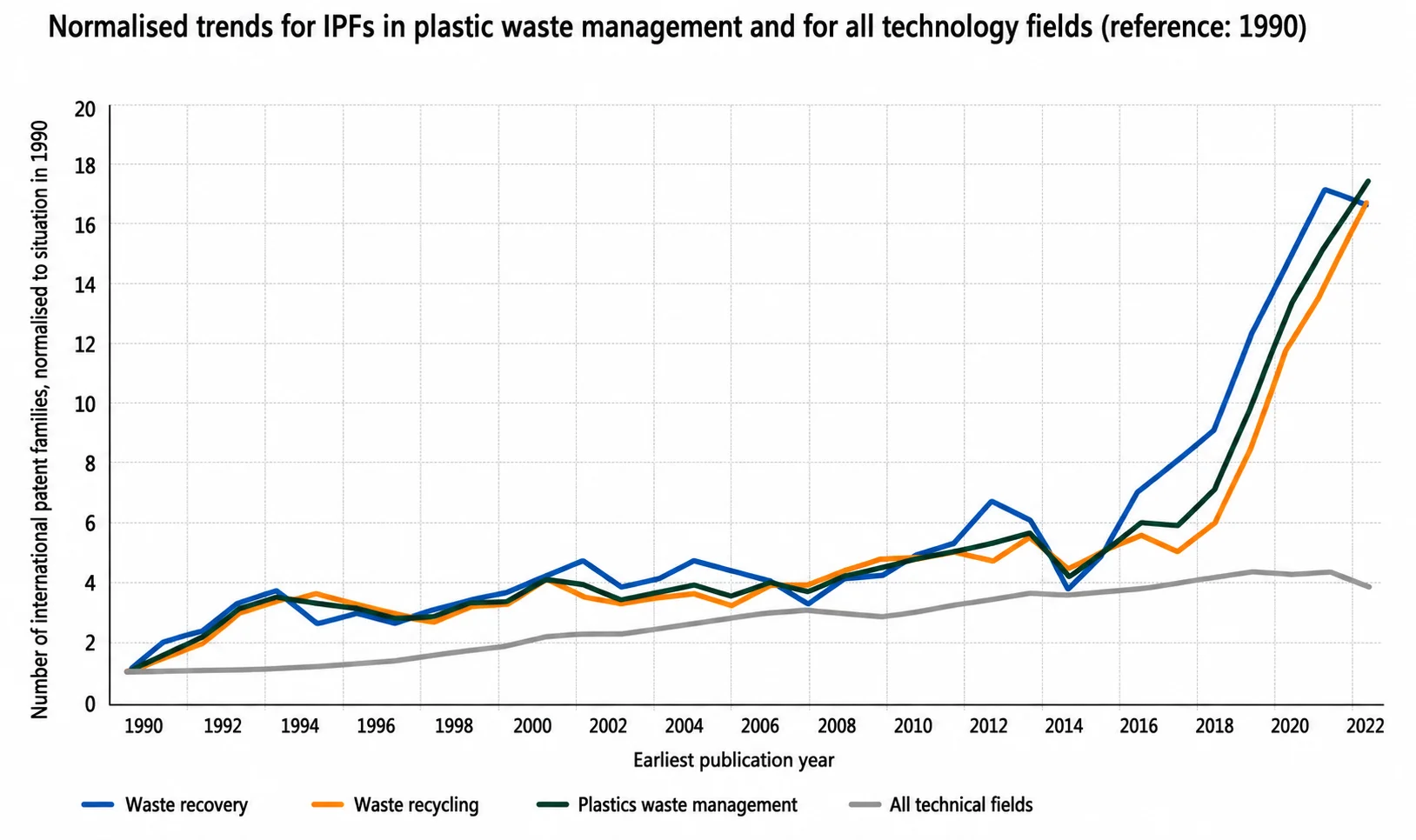
Figure 1: Normalised trends for IPFs in plastic waste management and for all technology fields (Steep rise in inventions to combat plastic waste: Europe in the lead, 2025)
This growing innovation trend is clearly reflected in global patent filing activities. As illustrated in Figure 1, patenting activity relating to plastic waste management technologies has increased substantially since 2015, with particularly rapid acceleration observed in the 2020s. This trend highlights the increasing commercial and technological interest in developing sustainable waste conversion and circular manufacturing solutions.
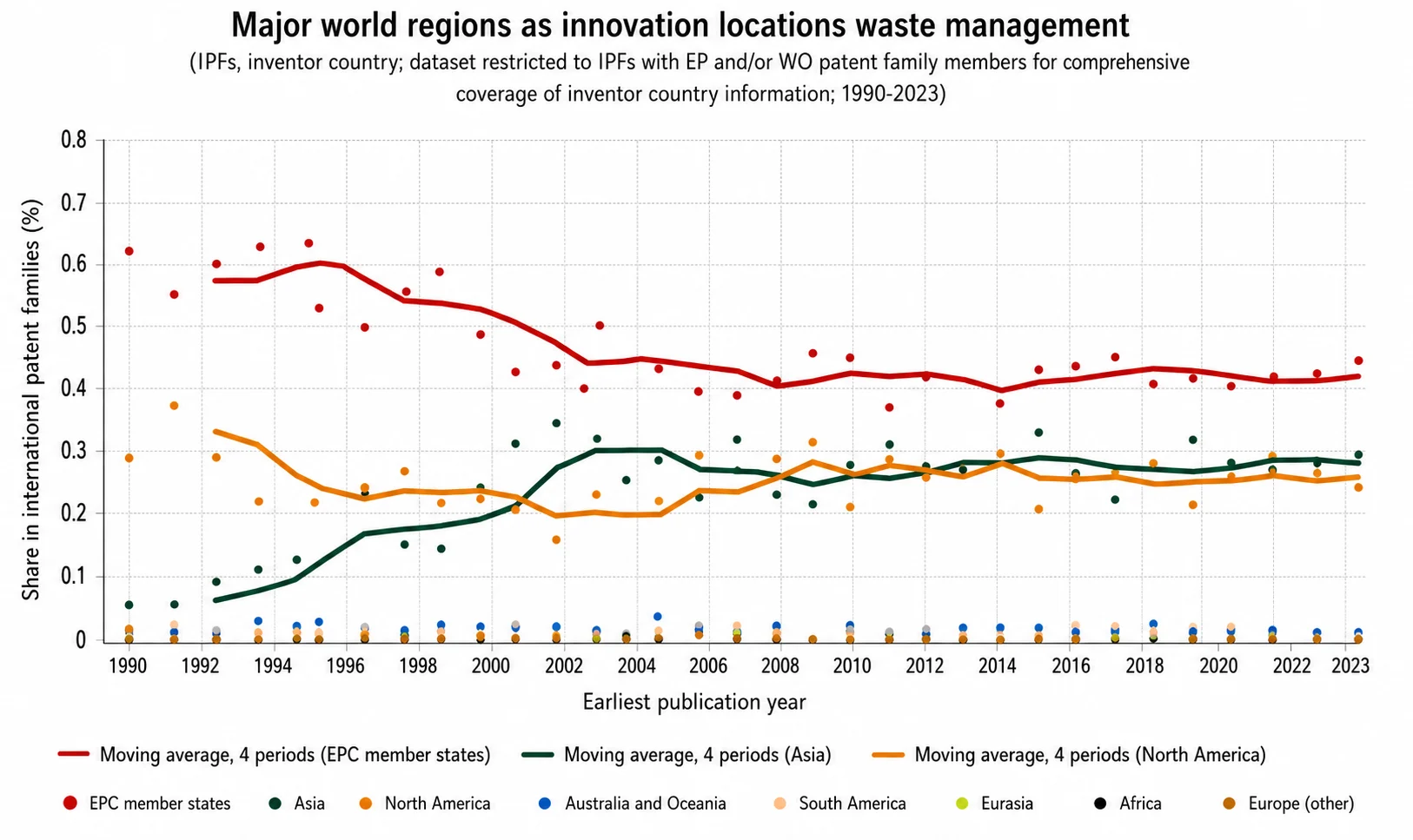
Figure 2: Major world regions as innovation locations in plastics waste management (Steep rise in inventions to combat plastic waste: Europe in the lead, 2025)
As illustrated in Figure 2, Europe has consistently maintained a leading position in patenting activity related to waste management innovation over the past three decades, driven primarily by countries such as United Kingdom, France, Germany and Sweden. Meanwhile, Asia has shown significant and sustained growth in patent activity, gradually reaching a level comparable to North America, with both regions accounting for approximately one-quarter of international patent families in recent years. This makes patent strategy particularly important in waste-to-value biotechnology because many commercially valuable inventions involve interconnected technical features rather than a single standalone breakthrough.
It is worth noting that the trends shown in Figures 1 and 2 relate specifically to plastic waste management and recycling technologies, which sit alongside but are not identical to, the broader biotech-driven waste valorization landscape discussed in this article (fermentation, enzymatic conversion, and metabolic engineering applied across agricultural, food-processing, and industrial waste streams). The 5.6 million bioeconomy-related patents identified by Kriesch and Losacker (2024) offer a more directly comparable benchmark for this sector’s overall innovation activity.
From a patent drafting perspective, identifying the true inventive concept is critical. A strong patent application should not merely describe the end product but should also clearly explain the technical problem being addressed, the limitations of existing technologies, and the technical advantages achieved by the invention.
What Technical Challenges Make Waste Conversion Hard to Patent?
One reason this field remains highly innovative is because waste streams are inherently difficult to process consistently. Unlike purified laboratory materials, industrial waste often varies significantly in composition, contamination level, moisture content, and chemical stability.
As a result, inventors frequently encounter technical challenges relating to feedstock inconsistency, microbial instability, low conversion efficiency, product contamination, energy consumption, and downstream recovery. These challenges become even more significant when attempting to scale a laboratory process into a commercially viable industrial operation.
Overcoming these limitations often requires substantial experimentation and process optimization. Even improvements that may appear incremental on the surface can involve significant technical ingenuity and deliver meaningful commercial advantages.
For instance, a process that improves microbial tolerance to contaminants or slightly increases conversion yield under industrial conditions may substantially improve economic viability at scale. Such improvements can become highly valuable patent assets when properly protected.
Why Does Early Patent Strategy Matter in Biotech?
One common issue faced by inventors and startups in this sector is delayed consideration of intellectual property protection. In waste-to-value biotech, that delay can be costly because public disclosure before filing may compromise patentability. Once an invention has been presented, published, or otherwise made public, the window for protecting the core idea may narrow quickly.
Early patent planning allows inventors to identify potentially patentable subject matter, which aspects are likely to be supported by the original disclosure, and which parts should be kept confidential until filing. That kind of planning can make the difference between a broad, useful patent position and a narrow or vulnerable one because inventions often evolve rapidly during research and scale-up stages. Therefore, filing strategically at the appropriate stage can help secure stronger protection while supporting future commercialization efforts.
Real-World Examples: Carbios, LanzaTech and Novozymes
These dynamics are already visible in real-world commercial technologies. Carbios has built a patent position around enzymatic depolymerization processes that break PET plastic waste down into reusable monomers; LanzaTech has patented gas-fermentation technology that converts industrial carbon emissions into ethanol and other chemical building blocks; and enzyme producers such as Novozymes hold extensive patent families covering enzymes derived from agricultural and food-processing waste streams.
These examples show how the individual technical building blocks described above, engineered strains, novel enzymes, optimized fermentation conditions, translate into commercially significant, heavily patented technology.
What's the Commercial Edge of Patenting Waste-to-Value Biotech?
From a business perspective, waste-to-value technologies are attractive because they answer a real market need. They can help reduce disposal costs, improve resource efficiency, and support sustainability commitments, all while generating a potentially new revenue stream. This commercial relevance makes waste-to-value biotechnology highly attractive to investors, manufacturers, and strategic partners.
For inventors, this means the technology has a story that resonates. It is not just about science, but it is about helping industry do more with less. In addition, governments and regulatory bodies worldwide are increasingly encouraging circular economy initiatives through grants, incentives, and sustainability frameworks. An invention that can convert “waste” into a reliable input or a higher-value product often stands out more clearly than a conventional incremental improvement.
Where Is the Patent Opportunity Strongest in Waste-to-Value Biotech?
The most promising areas in waste-to-value biotech tend to be those where technical complexity creates a barrier to entry. This includes engineered microorganisms with enhanced conversion capabilities, novel metabolic pathways, pretreatment technologies for complex biomass, improved fermentation control systems, product purification techniques, and integrated processing workflows. These are precisely where inventive solutions can be both scientifically meaningful and patentable.
For patent practitioners, this highlights the importance of carefully identifying the technical contribution that differentiates the invention from conventional technologies and ensuring that the claims are drafted to capture the commercially valuable aspects of the innovation. That is often where strong IP value is created.
This opportunity is especially pronounced in Southeast Asia, where large volumes of agricultural residues, palm oil biomass, rice husks and straw, sugarcane bagasse, and cassava waste are generated annually across Malaysia, Indonesia, Thailand, and Vietnam. Regional Governments are increasingly incentivizing circular economy and bioeconomy initiatives, and applicants who can convert these locally abundant waste streams into fuels, chemicals, or materials are well placed to combine strong commercial relevance with a defensible regional patent position.
What's Next for Waste-to-Value Biotech and Patent Strategy?
As industries continue shifting toward sustainable manufacturing models, waste-to-value biotechnology is expected to play an increasingly important role across sectors including energy, agriculture, chemicals, materials science, and consumer products. The technologies that succeed will be those that can handle real-world waste streams, produce reliable outputs, and scale economically.
For inventors, that means there is still plenty of room to innovate. For patent practitioners, it means there is real value in helping inventors identify what is truly protectable and draft it in a way that supports both prosecution and commercialisation. In other words, this is a field where good science and good patent strategy can reinforce each other.
If you are developing a waste-to-value technology and want to assess what is protectable or need help building a filing strategy that keeps pace with your research and development, our experienced patent teams all across our regional offices would be glad to discuss your invention and map out the right approach.
References:
Kriesch, L., & Losacker, S. (2024, November 30). A global patent dataset of bioeconomy-related inventions. Nature News. https://www.nature.com/articles/s41597-024-04163-6
Rene, E. R., Sarangi, P. K., Sànchez I Nogué, V., Schnürer, A., & Salvachúa, D. (2023, February). Current trends in waste valorization. Microbial biotechnology. https://pmc.ncbi.nlm.nih.gov/articles/PMC9871519/
Steep rise in inventions to combat plastic waste: Europe in the lead. (2025, April 29). epo.org. https://www.epo.org/en/news-events/news/steep-rise-inventions-combat-plastic-waste-europe-lead
Waste-to-Value Biotech Patents: FAQs
Can waste-to-value biotech inventions be patented?
Yes. Waste-to-value biotech inventions are commonly patentable, including engineered microbial strains, novel enzyme systems, pretreatment processes for difficult feedstock, optimized fermentation conditions, and downstream recovery methods — provided the invention is novel, inventive, and industrially applicable.
What makes a waste-to-value biotech invention patentable?
Patentability usually rests on a specific technical contribution rather than the end product alone — for example, a strain with improved contaminant tolerance, a more efficient conversion pathway, or an integrated process that scales economically.
When should I file a patent for a biotech waste-conversion process?
As early as possible relative to public disclosure. Presenting, publishing, or otherwise disclosing the invention before filing can compromise patentability, so early IP planning helps identify what to file and what to keep confidential.
Which Southeast Asian countries are strongest for waste-to-value biotech patents?
Malaysia, Indonesia, Thailand, and Vietnam are particularly active, given the large volumes of agricultural residues such as palm oil biomass, rice husks, and sugarcane bagasse generated in the region and growing government support for circular economy initiatives.