







Here are five inventions from that era that still carry the unmistakable “patent flavour”.
1. Radar: See Before You Strike
If there was one technology that quietly changed the outcome of World War II, it was radar.
Radar allowed nations to detect aircraft and ships long before they were visible. That early warning capability fundamentally changed air defence and naval warfare.
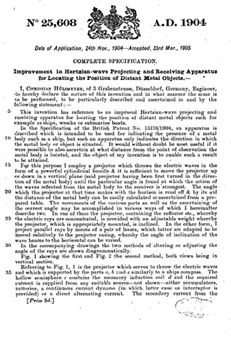
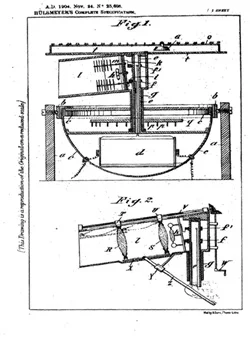
But radar did not suddenly appear out of thin air during the war. Its roots go much further back. One early intellectual ancestor appears in GB patent no. 190425608, filed in 1904 by a German inventor named Christian Hülsmeyer. His idea was simple but profound. An invention which used reflected radio waves to detect distant metal objects.
GB Patent No. 190425608
 |
 |
The conceptual seed of radar was already there decades before the war. What wartime urgency did was turn theory into an operational system. One of the most important breakthroughs came from the British development of the cavity magnetron, which enabled high-frequency microwave radar, the kind capable of detecting aircraft and submarines with far greater precision.
From a patent practitioner’s perspective, radar systems are fascinating. The real ingenuity rarely lies in a single component. It lies in the architecture of the system like transmitters, receivers, antennas, signal processing, and timing all working together.
Even today, when I review patents involving AI sensors or autonomous detection systems, I see echoes of those same system-level claim strategies.
2. The Proximity Fuse: When Timing Became Intelligence
Before the proximity fuse, artillery shells exploded on impact or after a fixed timer, a limitation against moving targets like aircraft. The proximity fuse solved that by detonating when near a target.
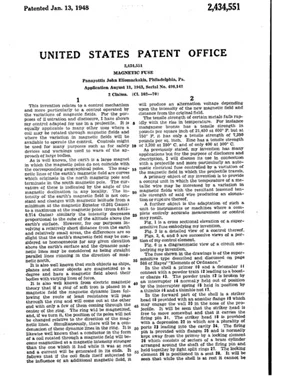
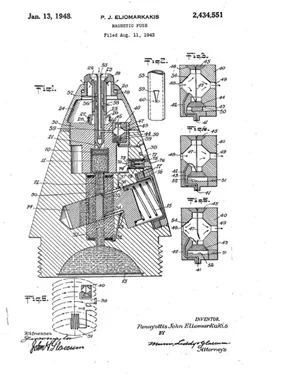
Much of this technology was classified, but later patents, such as US patent no. 2,434,551, reveal the engineering genius: combining radio detection, miniaturized electronics, ruggedized packaging, and high-shock mechanics, all in a shell small enough to survive being fired from a cannon.
From an IP strategy view, the fuse also illustrates the delicate balance between secrecy and disclosure, something patent professionals still navigate with sensitive technologies today.
US Patent No. 2,434,551 A
 |
 |
3. The Gundlach Periscope: Quiet Innovation That Changed Battlefield Awareness
Not every wartime invention was explosive.
Some of the most impactful innovations were mechanical improvements that dramatically changed how people perceived their environment.
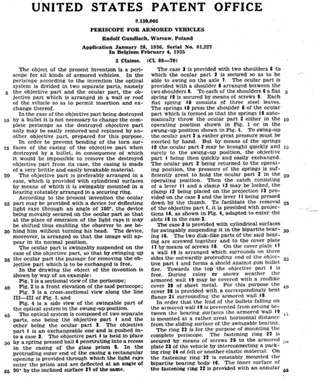
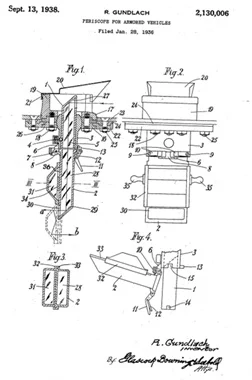
One example is the Gundlach Rotary Periscope, invented in 1938 by a Polish engineer named Rudolf Gundlach. Filed as a US patent no. 2,130,006, this invention allowed tank commanders to achieve 360-degree visibility from inside the vehicle, a deceptively simple idea with an enormous impact on battlefield awareness.
US Patent No. 2,130,006
 |
 |
Before this invention, commanders had extremely limited sightlines, often forcing them to expose themselves to danger to see beyond the tank. Gundlach’s rotating periscope solved this problem elegantly, combining safety with operational effectiveness.
The design was quickly adopted and licensed across several Allied tank programs, influencing tank periscope designs for years to come.
4. Spitfire Wing Design: When Engineering Elegance Meets Patent Protection
Aircraft design during WWII was a masterclass in engineering optimisation.
Speed, manoeuvrability, and structural strength had to coexist in increasingly demanding flight conditions.
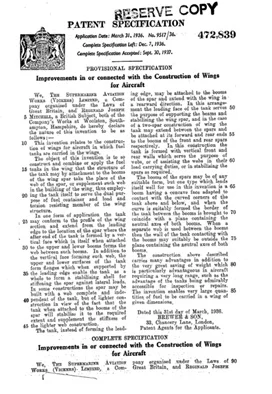
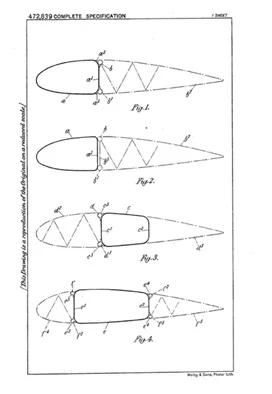
One example that appears in the patent archives is GB patent no. 472839, associated with Reginald Joseph Mitchell, the brilliant designer behind the iconic Spitfire fighter aircraft.
The patent relates to improvements in wing construction, a factor that contributed to the Spitfire’s agility and performance at altitude.
GB Patent No. 472839
 |
 |
From a patent drafting perspective, these kinds of filings are fascinating because they capture something subtle: small structural refinements that produce disproportionately large performance gains.
In modern practice, we see the same phenomenon in areas like aerospace composites, battery structures, or semiconductor architecture. The difference between success and failure often lies in details that might seem minor on paper.
But those details are exactly what patents are designed to protect.
Mitchell’s work is a simple reminder of how patent filings during war can capture subtle but crucial design refinements that make the difference between success and failure, not just big headline inventions.
5. Codebreaking and the Dawn of Computing
Perhaps the most intellectually transformative innovation to emerge from the Second World War was the birth of electronic computing.
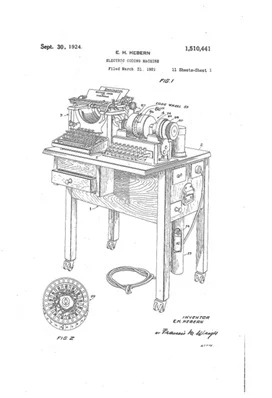
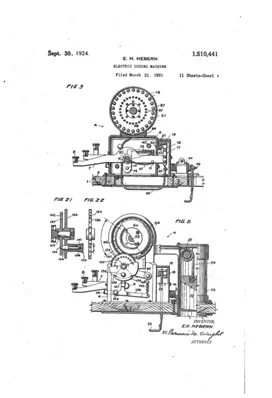
Interestingly, part of that story can be traced back to a much earlier patent. In 1924, U.S. patent no. 1,510,441 described an electromechanical rotor-based cipher machine designed to automate the encryption of messages. Hebern’s invention used rotating wired disks to transform plaintext into ciphertext through complex electrical permutations.
US Patent No. 1,510,441
 |
 |
At first glance, it was simply a clever cryptographic device. But the architecture it introduced rotating cipher rotors producing vast numbers of permutations became the conceptual foundation for later military encryption systems, most famously the German Enigma machines.
And that, in turn, created a profound technical challenge.
Breaking such rotor-based encryption could no longer be done reliably by hand. The sheer scale of possible permutations demanded mechanical and eventually electronic assistance. This pressure drove the development of codebreaking machines such as the Bombe and later Colossus computer, widely recognised as one of the earliest programmable digital computers, developed in Britain to automate cryptanalysis.
Much of this work remained classified for decades, which means the wartime patent record captures only fragments of the real technological breakthroughs. But the engineering principles that emerged from those codebreaking laboratories, vacuum-tube logic circuits, automated signal analysis, and programmable computation became the foundation for the explosion of computing patents in the years that followed.
In many ways, the digital world we live in today traces part of its lineage back to a quiet chain of innovation.
Reflections from the Patent Trenches
When you spend more than twenty years working with inventors, you start to appreciate something deeply human about patents.
Every patent application is essentially a snapshot of a moment in time, a moment when someone looked at a problem and decided it could be solved differently.
The WWII era stands out in patent history not because it glorified conflict, but because it revealed how innovation behaves under extreme pressure. Entire technological ecosystems like radar, electronics, aviation, computing, accelerated in ways that shaped civilian life for decades afterward.
Looking at today’s geopolitical tensions, I am reminded again that innovation never happens in a vacuum. It grows out of the economic, political, and social realities around us. What we do with those inventions, how we protect them, share them, or regulate them, ultimately determines whether they serve destruction or progress.
For those of us working in intellectual property, that responsibility is not abstract. It is embedded in every patent claim we draft, every strategy we design, and every inventor we support. And perhaps that is the quiet lesson history keeps offering us:
Innovation may be born in urgency, but its legacy is shaped by stewardship.
To everyone navigating uncertain times, stay safe. May the inventions of today reflect not only urgency, but wisdom and humanity.