







By Lakshman Dharan Nair
If your entire trademark appears inside someone else’s trademark, has the other trader come too close?
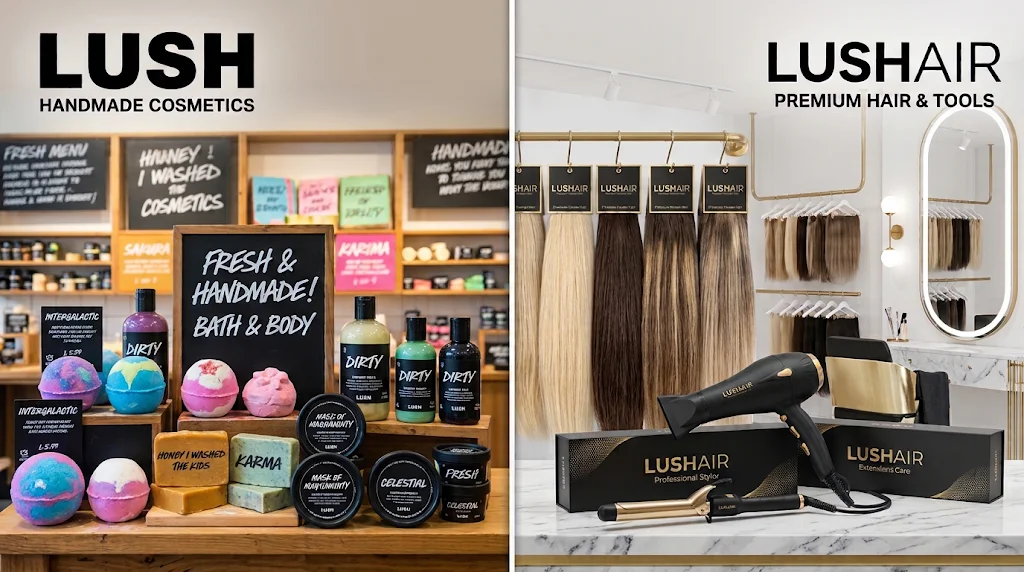
At first glance, LUSH had an obvious concern. The four letters “L-U-S-H” appear intact at the beginning of “LUSHAIR”, and both brands operate in the beauty and personal-care space. Yet trademark similarity is rarely a spelling exercise. The question is not simply what letters two marks share, but what consumers see, hear and understand when encountering the marks as a whole.
That question was at the heart of Cosmetic Warriors Limited v Genpulse Pte Ltd [2026] SGIPOS 1. In a decision issued on 13 January 2026, the Intellectual Property Office of Singapore (“IPOS”) dismissed the opposition brought by the owner of the LUSH brand, allowing LUSHAIR to proceed to registration.
Four Letters at the Centre of the Fight
Cosmetic Warriors Limited (“Opponent”), the UK-based company behind the globally recognised LUSH brand, opposed a trademark application filed by Genpulse Pte Ltd (“Applicant”) in Class 44, covering beauty, skin care and dermatology-related services, for the following mark:

The Opponent forms part of the LUSH Group, Which was founded in 1995 and operates over 880 shops in more than 50 countries, specialising in skincare, beauty and hair care products. The Applicant, on the other hand, is a Singapore company offering technology-driven dermatological and beauty services, using a propriety device and AI-driven software to analyse images of a customer’s skin and scalp.
The Opponent believed that LUSHAIR was too similar to its LUSH trademark and could confuse consumers. It opposed the application on three grounds under Singapore’s Trade Marks Act 1998: likelihood of confusion (section 8(2)(b)). Its case appeared intuitive: “LUSH” was clearly present at the beginning of “LUSHAIR”, consumers might pronounce the latter as “LAST-HAIR” (as the Opponent said the Applicant’s own social media posts suggested), and both businesses operated within overlapping beauty and skincare sectors.
The Applicant responded that LUSHAIR should be viewed as a whole, not dissected into convenient parts. Its mark also contained a prominent device element, while the word itself conveyed a more specific idea relating to healthy, luxuriant hair. So, was LUSHAIR simply LUSH with three letters attached, or had those three letters, together with the device, created something sufficiently different?
Assess Your Trademark Risk
A Mark Is More Than Its Letters
Principal Assistant Registrar, See Tho Sok Yee (“the Registrar”) applied the established three-step test laid down in Staywell Hospitality Group v Starwood Hotels & RA Mark esorts Worldwide [2014] 1 SLR 911: similarity of marks, similarity of goods or services and, finally, likelihood of confusion. Importantly, the first two are threshold requirements. If mark similarity fails, the inquiry effectively ends.
A preliminary finding set the tone. As an ordinary English dictionary word, LUSH was assessed as having only an average (medium) level of inherent distinctiveness. It therefore did not benefit from the higher threshold that highly distinctive marks enjoy before a competing mark will be considered dissimilar.
On visual similarity, the Registrar found that LUSHAIR could not fairly be reduced to the letters “LUSH” embedded within it.
The Application Mark included a stylised white “L”, shaped like a strand of hair and encircled in ana dark orb. This device occupied more than half of the mark and was visually connected to both the first letter of LUSHAIR and the idea of hair itself. The Registrar therefore treated the device and word elements as a unified composite whole, rather than treating the logo as mere decoration. Structural differences reinforced the point: LUSH is a plain four-letter word mark, while LUSHAIR combines a seven-letter word with a prominent device.
The point is commercially important: in a composite trademark, words do not invariably monopolise the consumer’s attention. A sufficiently prominent and coherent device can materially change the identity of the mark.
LUSH-HAIR, LUSH-AIR or LU-SHAIR?
Much of the hearing was spent on pronunciation, and this is where the dispute became particularly interesting.
The Opponent maintained that LUSHAIR would be pronounced “LUSH-HAIR” or possibly “LUSH-AIR”, leaving the entirety of LUSH audibly intact. The Applicant proposed several possibilities, including “LU-SHAIR”, “LUS-HAIR” and “LUSH-AIR”.
IPOS accepted that an average consumer encountering the unfamiliar word would likely notice “LUSH” and pronounce the first syllable accordingly. But that was not the end of the inquiry. The endings “HAIR” or “AIR” were hard sounds that could not simply be slurred or ignored, and the mark had to be heard as a whole. Qualitatively, the ending mattered as much as the beginning. Quantitatively, the marks shared just one syllable, and the Registrar cautioned that readily finding a one-syllable mark similar to every longer mark incorporating it would unduly limit other traders’ choice of marks. On both approaches, the marks were found aurally dissimilar.
Sharing the first note, in other words, does not necessarily make two melodies the same.
When the Whole Changes the Meaning
Conceptually, the same principle prevailed.
The Opponent argued that LUSH conveyed ideas of attractiveness and luxury and that even a “LUSH-AIR” reading would suggest the air or aura of LUSH. The Registrar found that argument contrived, while accepting that LUSH evokes attractiveness and luxury as well as vigorous, healthy growth (think of a lush forest). LUSHAIR, however, conveyed the more specific idea of full, healthy and luxuriant hair.
Although the concepts shared some common ground, IPOS considered that common denominator too low to make the marks conceptually similar.
The Registrar consequently found the marks visually, aurally and conceptually dissimilar. The Opponent therefore failed at the very first step of the three-step test.
Even Similar Businesses Do Not Guarantee Confusion
Interestingly, the goods and services themselves were similar, a point the Applicant conceded at the hearing. The Opponent’s skincare, body care and hair care products and its beauty and skin care services clearly overlapped with the Applicant’s services.
Strictly speaking, IPOS did not need to go further once mark similarity had failed. Nevertheless, the Registrar made several obiter observations on confusion and these contain some of the decision’s most useful commercial lessons.
Consumers purchasing skincare, body care, hair care and related beauty services generally exercise a greater degree of thought and care than someone making an indifferent or hurried purchase. Even if mark similarity had been established, the Registrar considered confusion more unlikely than likely.
Nor could the Opponent strengthen its case by pointing to its own mobile app or its limited-edition collaborations with brands such as Barbie, SpongeBob and Minecraft. The Registrar treated these as the Opponent’s own marketing choices rather than features inherent in the goods and services, and therefore not relevant factors in assessing confusion.
Commercial Intuition Is Not Evidence
Perhaps the sharpest lesson came from the Opponent’s argument that consumers might perceive LUSHAIR as a brand extension of LUSH.
The Opponent argued that launching variants under extensions of a brand name was common commercial practice in the personal-care industry. When asked for supporting evidence at the hearing, however, the Opponent’s counsel acknowledged that it was not on hand. The Registrar added that even evidence of the Opponent’s own brand extensions would not have settled the point, observing memorably that:
“one business doth not an industry make”
That sentence may carry a lesson well beyond the beauty industry. Commercial intuition, however plausible, is not evidence. If an opposition depends on how an industry supposedly behaves, the safer course is to prove that behaviour rather than invite the tribunal to assume it.
The Bigger Lesson
The opposition ultimately failed on all grounds, and LUSHAIR was permitted to proceed to registration. The claims based on the well-known mark provisions and passing off, fell with the finding on similarity: the well-known mark ground also requires marks-similarity, and without similarity or a likelihood of confusion there could be no misrepresentation for passing off. The Opponent was also ordered to pay the Applicant’s costs of S$8,050.
The decision does not give businesses a licence to embed established trademarks within longer names. What it demonstrates is something subtler: trademark similarity cannot be determined simply by circling the letters two marks have in common.
LUSH was undeniably sitting inside LUSHAIR. But IPOS looked beyond those four letters, to the device, pronunciation, concept and overall impression, and concluded that the marks told consumers different stories.
Three Key Takeaways
- Sharing letters is not the same as sharing an identity. Marks are compared as wholes. Where the earlier mark is a short dictionary word of only average distinctiveness, a later mark that adds a meaning-changing ending and a prominent, integrated device may be found dissimilar, even if the earlier mark sits intact at its start. Owners of short word marks should realistically assess the reach of their rights before launching an opposition.
- Market behaviour must be proved, not presumed. Arguments about how an industry operates, such as the prevalence of brand extensions, need evidence, and proof of one brand's own practice may not establish an industry norm. A brand owner's own marketing choices, such as apps or third-party collaborations, will not be counted towards a likelihood of confusion.
- Build the mark as a unified whole. For businesses creating a new brand, a device that ties visually and conceptually to the word, rather than sitting beside it as decoration, can be decisive in creating distance from an earlier mark. A clearance search before filling remains the best way to test whether a new name has come too close.
Perhaps that is the paradox at the heart of LUSH v LUSHAIR. A trademark can sit inside another mark without necessarily defining it. Sometimes, the letters two brands share matter less than the identity built around them.
For further questions or advice on how this decision may affect your trademark applications or intellectual property portfolio, please contact us at kass@kass.asia.